Based at the Coylumbridge Hotel near Aviemore 19 cars gathered in glorious weather for our three night stay. At our dinner for the first evening we were entertained by two local historians and musicians, who sang traditional songs, telling stories which helped understanding of the area we would travel through over the next two days.
Day one
We set out through Nethy Bridge, Grantown-on-Spey and on to Lochindorb with its Castle. Meaning the ‘loch of trouble’ in Gaelic, Lochindorb Castle is a ruined 13th-century stronghold of enclosure with round corner towers, occupying all the island It was a property of the Comyns. The castle was occupied by the English during the Wars of Independence, and Edward I of England visited in 1303. It was held again for the English in 1335 when Andrew Moray the Regent besieged it unsuccessfully, and had to withdraw before a large army led by Edward III. The castle was then used as a prison. At the end of the 14th century, it was a property of Alexander Stewart, the Wolf of Badenoch. Lochindorb passed to the Douglas Earls of Moray, who strengthened it against James II, but was dismantled after their fall in 1455, and not reused. The castle is mentioned in the process of forfeiture against the Black Douglases, including Archibald ‘pretended Earl of Moray’. The iron yett was taken to Cawdor Castle. Substantial remains survived at the end of the 18th century. The property passed to the Stewart Earls of Moray, then was sold to the Campbells of Cawdor in 1606, who sold it to the Ogilvie Earl of Seafield in 1750.
On to our first visit and coffee at Cawdor Castle, one of the most magnificent and well-preserved strongholds in Scotland, Cawdor Castle incorporates a tall plain tower, dating from the 14th century, although the parapet and upper works were added in 1454. The castle has a deep ditch, and is reached by a drawbridge. Mainly three-storey ranges, gabled and crowned with bartizans and corbelled-out chambers, were built on all sides of the main tower in the 16th and 17th centuries. There is a pit prison. The castle sits in fine gardens and grounds, with a walled garden dating from qbout 1600 and later used as the kitchen garden, a flower garden, and a wild garden, and the estate covers some 42,000 acres.
Across the drawbridge defending the entrance is a massive iron yett, which was brought here from Lochindorb Castle after 1455. The main tower rises to four storeys and a garret within a flush parapet, and has very thick walls pierced by small windows. There are bartizans at each of the corners, as well as machicolated projections. The entrance is now in the basement, but was originally at first-floor level. Both the basement and the third floor are vaulted. A straight stair, in the thickness of one wall, leads up to the hall on the first floor – although this would formerly have been a stair down to the cellars. A turnpike stair climbs to the upper floors. The title Thane of Cawdor is associated with Macbeth, but Duncan was not murdered here, as the castle is not nearly old enough, and hewas killed in battle near Spynie. The Calders had an earlier stronghold near here [NH 858512], but nothing remains.
Scottish Tour 2023


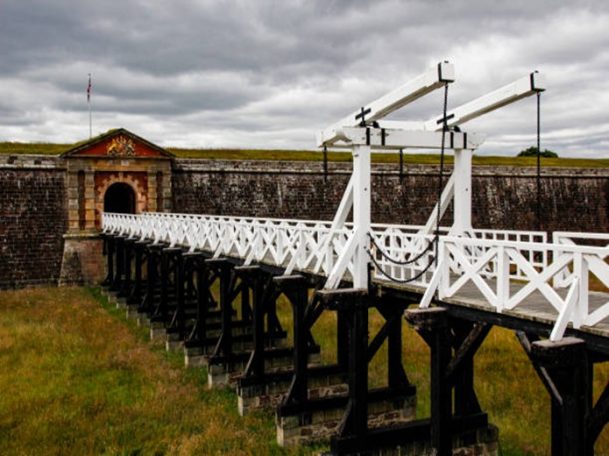
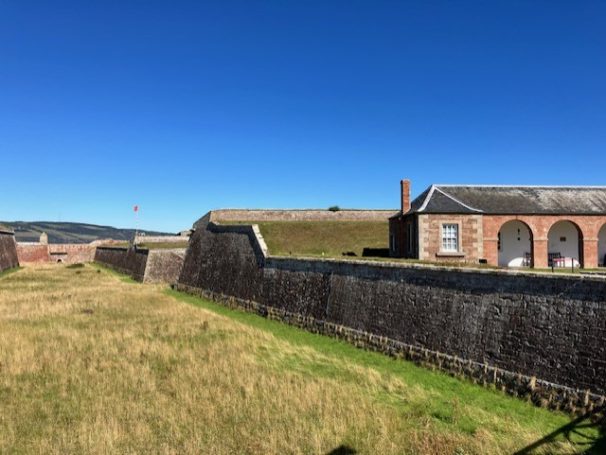
Leaving Cawdor we move to Fort George. Strategically located on a promontory jutting into the Moray Firth, the army base was designed to evade capture. Fort George was built on a monumental scale, making use of sophisticated defence standards, with heavy guns covering every angle.
The boundary walls of the fort housed:
- accommodation for a governor, officers, an artillery detachment and a 1,600-strong infantry garrison
- more than 80 guns
- a magazine for 2,672 gunpowder barrels
- ordnance and provision stores
- a brewhouse
- a chapel
Countering the Jacobite threat
The Jacobite Rising of 1745–6 proved to be the last attempt by the Stuart dynasty to regain from the Hanoverians the thrones of Scotland and England and Wales.
Fort George was one of the ruthless measures introduced by the government to suppress Jacobite ambitions after the nearby Battle of Culloden. It was intended as the main garrison fortress in the Scottish Highlands and named after George II.
From Fort George we visited The Culloden Battle Field